
Bitcoin Miners Are Becoming AI Companies — Here's Why
Bitcoin miners are abandoning traditional crypto mining and pivoting toward AI data center infrastructure due to unsustainable mining economics.


🚀 Bitcoin Miners Are Quietly Becoming AI Companies — Here's What That Means for You
Is the bitcoin mining industry dying? Not exactly — but it's changing faster than most people realize.
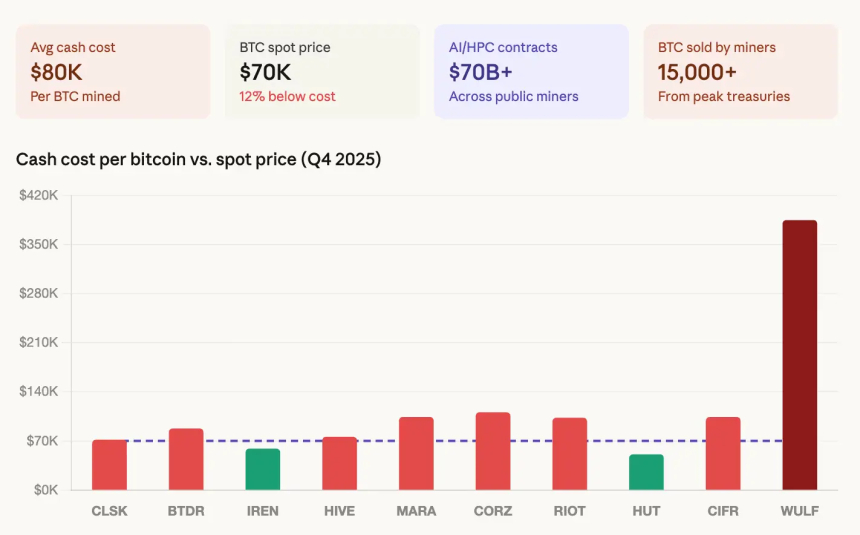
Here's a number that tells the whole story: it currently costs miners about $80,000 to produce a single bitcoin, yet bitcoin is selling for around $70,000. That's a loss of nearly $19,000 on every coin they create. No business can survive those numbers for long, and the smartest players in the mining world aren't waiting around to find out what happens next.
Instead, they're transforming themselves into artificial intelligence (AI) infrastructure companies — and selling their bitcoin to pay for the switch.
Why Bitcoin Mining No Longer Pays the Bills
To understand the shift, you first need to grasp why mining has become so expensive.
Bitcoin mining involves powerful computers solving complex puzzles to verify transactions on the blockchain. Miners earn bitcoin as a reward. But after the most recent halving event — which cuts miner rewards in half — the income dropped sharply while costs stayed high.
Here's what the numbers look like today:
- Average cost to mine 1 BTC: ~$79,995
- Current BTC market price: ~$70,000
- Average loss per bitcoin mined: ~$19,000
On top of that, electricity costs are brutal. Miners running standard equipment need electricity priced below $0.05 per kilowatt-hour just to break even. For many operations, that's simply not achievable.
The industry hit a painful milestone in early 2026 when "hash price" — the money a miner earns per unit of computing power — fell to an all-time post-halving low. Three consecutive downward difficulty adjustments followed, something that hadn't happened since mid-2022.
The $70 Billion Pivot to Artificial Intelligence
Rather than shutting down, major mining companies are doing something bold — they're converting their massive computing facilities into AI data centers.
Why? Because AI companies desperately need computing power, and miners already have the infrastructure. The economics are dramatically better:
| Infrastructure Type | Cost Per Megawatt | Profit Margins |
|---|---|---|
| Bitcoin Mining | $700K – $1M | Low & unstable |
| AI / HPC Data Centers | $8M – $15M | Above 85%, multi-year contracts |
Over $70 billion in AI and high-performance computing (HPC) contracts have already been signed across the public mining sector. Some headline deals include:
- Core Scientific & CoreWeave: $10.2 billion deal over 12 years
- TeraWulf: $12.8 billion in contracted HPC revenue
- Hut 8: $7 billion, 15-year AI infrastructure lease
- Cipher Digital: Multi-billion agreement with Google-backed Fluidstack
Analysts predict that by the end of 2026, listed mining companies could earn up to 70% of their total revenue from AI — up from roughly 30% today. Core Scientific already gets 39% of its revenue from AI colocation. These aren't mining companies anymore. They're data center businesses that happen to still run some bitcoin equipment on the side.
How Are Miners Paying for This Massive Shift?
Transforming a bitcoin mining farm into an AI data center costs enormous amounts of money. Miners are funding this transition in two main ways:
1. Taking on Huge Debt
Mining companies are borrowing at a scale never seen before in this industry:
- IREN is carrying $3.7 billion in convertible notes
- TeraWulf holds $5.7 billion in total debt
- Cipher Digital issued $1.7 billion in secured notes, causing its quarterly interest payments to jump from $3.2 million to $33.4 million in a single quarter
These are not small business loans — these are bets that AI revenue will grow fast enough to cover the repayments.
2. Selling Their Bitcoin
Perhaps more surprisingly, miners are liquidating their own bitcoin reserves to raise cash:
- Core Scientific sold roughly 1,900 BTC (worth ~$175 million) in January 2026 and plans to sell nearly all remaining holdings
- Bitdeer brought its bitcoin treasury all the way down to zero in February
- Riot Platforms sold 1,818 BTC worth approximately $162 million in December
Even Marathon Digital, the largest bitcoin holder among public miners with over 53,000 BTC, quietly updated its policy to allow sales from its full reserve — partly because its bitcoin-backed loan hit a dangerous 87% loan-to-value ratio.
What Does This Mean for Bitcoin's Security?
Here's where things get really interesting — and a little concerning.
The companies selling bitcoin and redirecting resources toward AI are the same companies that keep the bitcoin network secure. Bitcoin's security depends on miners actively participating in the network. When mining becomes unprofitable and AI becomes more attractive, the natural response is to scale back mining operations.
The data already shows this happening. Bitcoin's total network computing power (hashrate) peaked at around 1,160 exahashes per second in October 2025 and has since fallen to roughly 920 EH/s.
If this continues, the network's security could weaken. However, there's a silver lining: fewer miners also means lower difficulty, which can make the remaining miners more profitable — and may attract new participants back.
The Stock Market Has Already Picked a Winner
Investors aren't waiting to see how this plays out. The market has already placed its bets:
- Mining companies with AI contracts trade at 12.3x next-twelve-month sales
- Pure bitcoin miners trade at just 5.9x
The market is literally paying more than double for companies that have secured AI revenue. That valuation gap is a powerful incentive pushing even hesitant miners toward the AI transition.
Next-Gen Mining Hardware: A Possible Lifeline?
Not every miner is giving up on bitcoin. Some are betting on next-generation mining machines to turn the economics around.
Bitmain's S23 series and Bitdeer's proprietary SEALMINER A3 both operate below 10 joules per terahash — roughly half the energy consumption of current standard equipment. At that efficiency, mining could become profitable again even at today's prices.
The catch? Deploying new hardware requires capital — the same capital most companies are currently channeling into AI infrastructure. It's a race between two very different visions of the future.
Where in the World Is Mining Happening Now?
The geography of bitcoin mining is also shifting:
- The United States, China, and Russia together control about 68% of global hashrate, with the U.S. gaining ground
- Paraguay and Ethiopia have entered the global top 10, driven by large-scale operations from HIVE Digital and Bitdeer respectively
Emerging markets with cheap electricity are becoming increasingly important as established miners pivot toward AI.
What Happens Next? It All Comes Down to One Number
According to research firm CoinShares, the entire future of this industry hinges on bitcoin's price.
- If BTC returns to $100,000 by year-end: mining margins recover, the AI pivot slows, and the industry stabilizes
- If BTC stays at $70,000 or below: the AI transition accelerates and the traditional mining industry continues to shrink
- A sustained drop below $70,000 could trigger mass miner exits — but paradoxically benefit survivors through reduced competition
CoinShares forecasts total network hashrate could reach 1.8 zetahashes by end of 2026 and 2 zetahashes by early 2027 — but only if bitcoin prices cooperate.
The Bottom Line
The bitcoin mining industry entered this decade as companies whose entire purpose was securing a decentralized financial network. Today, those same companies are signing billion-dollar AI contracts, taking on infrastructure-scale debt, and selling the very asset they were created to mine.
Whether this is a temporary survival strategy or a permanent transformation depends on forces no one can fully control — chiefly, the price of bitcoin. What's clear is that the line between "bitcoin miner" and "AI data center company" is disappearing fast.
What do you think — will bitcoin bounce back to $100K and save traditional mining, or is the AI pivot here to stay? Drop your thoughts in the comments below, and share this post with anyone following the crypto and AI space!
Share
What's Your Reaction?
 Like
0
Like
0
 Dislike
0
Dislike
0
 Love
0
Love
0
 Funny
0
Funny
0
 Angry
0
Angry
0
 Sad
0
Sad
0
 Wow
0
Wow
0