Q2 2026 robotics demand increased across industries, reports A3
While progress in artificial intelligence and humanoid robots continues to capture public and investor interest, industrial automation is still the leading segment in robotics. The Association for Advancing Automation, or A3, marked modest growth in North American orders in the Q2 of 2026. North American…
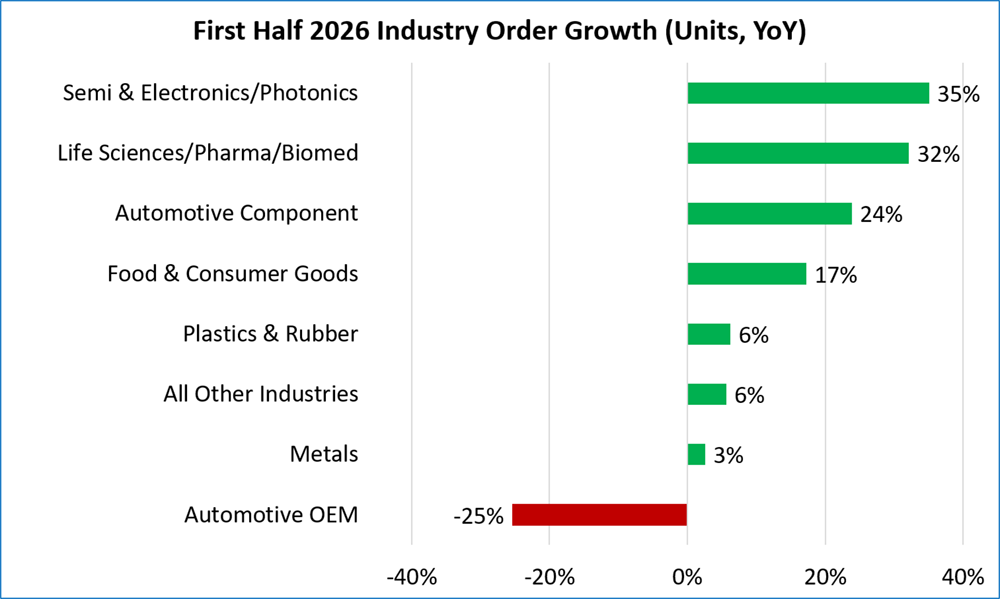
While progress in artificial intelligence and humanoid robots continues to capture public and investor interest, industrial automation is still the leading segment in robotics. A3 noted that it based quarterly year-over-year growth rates on a consistent reporting cohort.
A3 calculated its first-half comparisons from aggregate reported totals for the periods shown. Several industries posted double-digit year-over-year gains in robot orders during the second quarter.
What Happened
In the second quarter alone, companies ordered 1,137 cobots valued at $44 million, representing 12.7% of total units and 7.1% of quarterly revenue. Collaborative robot adoption remained particularly strong in healthcare and electronics, where cobots accounted for 43.7% and 36.5% of first-half.
The Association for Advancing Automation, or A3, marked modest growth in North American orders in the Q2 of 2026.
North American companies ordered 8,940 robots valued at $622 million in Q2, the association reported.
Compared with the second quarter of 2025, this represented a 4.3% increase in units ordered and a 21.3% increase in revenue.
Key Details
Despite continued uncertainty across the broader economy, manufacturers continued investing in automation during the first half of 2026. Manufacturing PMI (purchasing manager’s index) remained in expansion territory for a sixth consecutive month in June, with new orders and production continuing to grow.
Second-quarter results brought first-half totals to 17,995 units valued at $1.166 billion, representing 2.0% growth in units and 6.6% growth in order value over the first half of 2025.
A3 said that robot orders in first half of 2026 continued a trend from the past several quarters: Robotics demand is becoming increasingly diversified across industries.
Semiconductors, electronics, and photonics increased 38% year over year, while automotive components grew 20%.
Why It Matters
Federal Reserve data also showed manufacturing output 1.1% above its year-earlier level in June. The Ann Arbor, Mich.-based Association for Advancing Automation said it is the leading global advocate for the benefits of automating.
Food and consumer goods and metals each increased 18%, as life sciences, pharmaceuticals, biomedical posted 9% growth over 2025.
Non-automotive customers accounted for 56% of units ordered during the 2026 quarter, continuing the increasing adoption of robots across a variety of industries, said A3.
What Reports Say
Coverage of the story so far points to:
Force- and power-limited robot arms continued to represent a significant portion of automation investments during the first half of 2026, noted A3.
Companies ordered 2,774 collaborative robots valued at $114 million, accounting for 15.4% of all robot units ordered and 9.8% of total order revenue.
Continued reporting by The Robot Report as more details emerge